
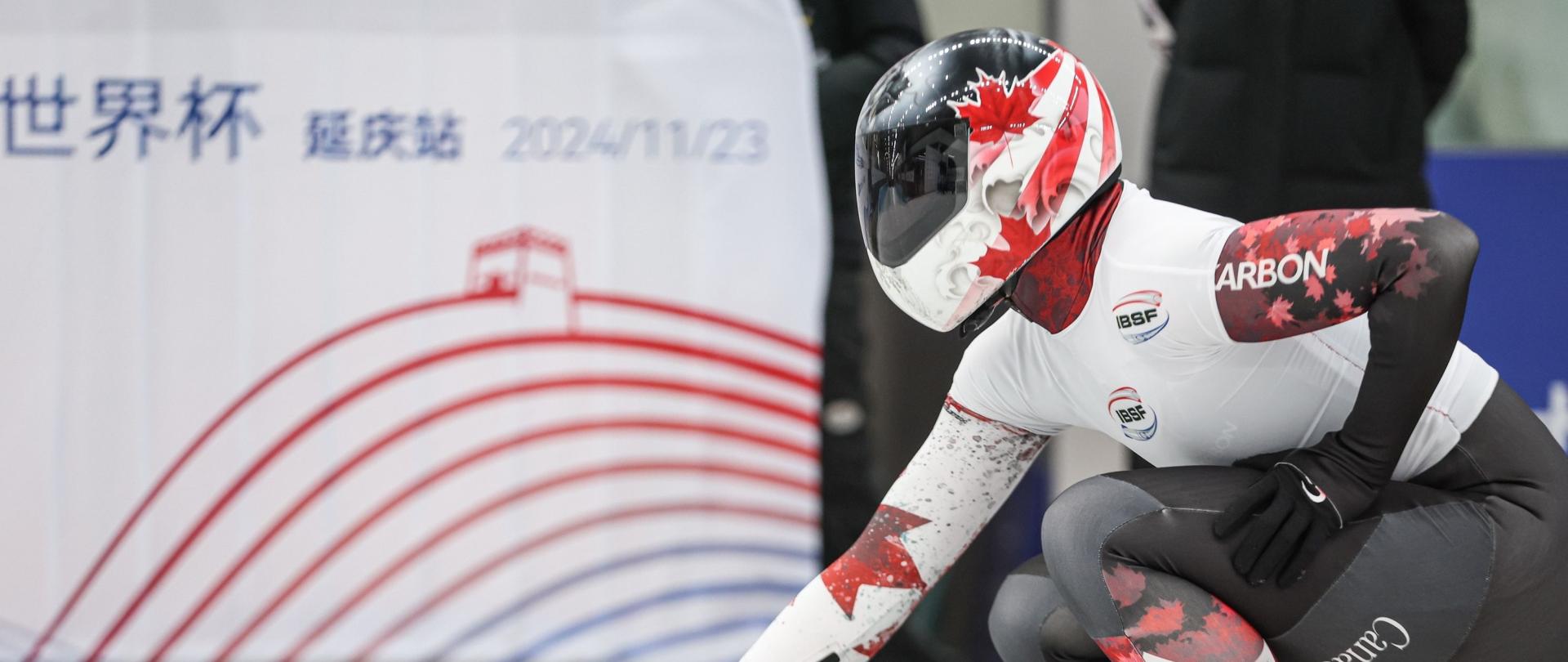
Three-Time Olympic Skeleton Athlete Jane Channell Slides into Retirement
CALGARY— One of the most respected athletes in the history of the Canadian skeleton program, Jane Channell, has announced her retirement from the sport, bringing to a close an extraordinary career that spanned more than a decade at the highest levels of international competition.
“To be inside a highly physically demanding sport for 15 years is a long time and I feel like now is the right time to move on,” said Channell. “Skeleton is my family, and that is why it is difficult to step away and why it has taken me so long to come to terms with doing this. The community that the Canadian program has right now is like nothing else. Through the ups and downs, and all of the support – loud and quiet - it’s been a ride.”
At 37 years old, Channell departs the sport of head-first sliding as a three-time Olympian, four-time World Cup medallist, Crystal Globe winner, and a cornerstone of Canada's national skeleton program. Beyond her competitive accomplishments, she leaves behind a legacy defined by leadership, resilience, and an unwavering commitment to helping elevate the next generation of Canadian athletes.
"Jane has been the heartbeat of our program for many years," said Joe Cecchini, high performance director and head coach, National Skeleton Program. "Her professionalism, work ethic, and willingness to support teammates have had an immeasurable impact on Canadian skeleton. She has been a leader through every phase of her career and played a critical role in rebuilding and strengthening our program into what it is today."
A resident of North Vancouver, Channell first discovered skeleton after watching the sport slide permanently into the Olympic program at Salt Lake City 2002. A former varsity sprinter at Simon Fraser University, Channell was drawn to the adrenaline and precision of skeleton. Inspired by the speed and excitement of the discipline, she eventually found her way to the Whistler Sliding Centre, where a passion quickly turned into a pursuit of excellence.
Following graduation in 2011, she moved to Whistler, B.C. to immerse herself fully in the sport before earning a spot on Canada's national development team and later relocating to Calgary to continue the pursuit of her new-found Olympic dream.
“Looking back on when I first started, I could not have imagined that it could take me to the places it did. I was lost at that time. I was confused and I was likely avoiding the real world,” laughed Channell. “As I reflect on it now, moving up to Whistler to do skeleton, really allowed me to find myself. It gave me closure on things while allowing myself to grow into who I have become today.”
Her rise through the international ranks was rapid. Channell captured the overall North American Cup title in 2012-13 before progressing through the Intercontinental Cup circuit and earning her first IBSF World Cup start during the 2013-14 season.
Channell’s breakthrough on the world stage came at the 2015 IBSF World Championships, where she narrowly missed the podium by just .06 seconds, finishing fourth in her World Championship debut. One of the most explosive athletes off the start block, the performance set the stage for a standout 2015-16 campaign that included her first two World Cup podium finishes and a third-place ranking in the overall World Cup standings, earning her a Crystal Globe as one of the world's top skeleton athletes.
Over the course of her career, Channell represented Canada at three Olympic Winter Games – PyeongChang 2018, Beijing 2022, and Milano Cortina 2026. Her top Olympic result came in South Korea, where she finished 10th. Her four World Cup medals where highlighted by silver-medal performances in Park City and Whistler. She added a bronze medal in Königssee and in Winterberg, and also earned a silver medal at the 2020 IBSF World Championships in the mixed team event alongside fellow Canadian Dave Greszczyszyn.
“Aside from representing Canada at three Olympics with my friends and family watching, there are many highlights. One of my favourites was with Dave (Greszczyszyn) in the inaugural team event when we came second by .01. We were the clear underdogs and to have that moment with him was special,” said Channell, who was also proud to have the opportunity to mentor Hallie Clarke and Josip Brusic through their first Olympics in 2026.
“What I’m most proud of, though, would be the amount of grit and drive that I knew I had, but didn’t fully believe in yet. It was when I was able to pull through some incredibly tough moments, to deliver some of my best races under pressure, that showed me how strong I am.”
While her results placed her among the world's best, Channell's influence extended far beyond the finish line. During the lead-up to Milano Cortina 2026, she became one of the key leaders in the rebuild of Canada's skeleton program, mentoring younger athletes and helping create a culture centered on accountability, excellence, and team success.
“I thought 2022 was going to be my last year, but I wasn’t okay leaving the program and the sport in Canada, in the state it was in at that time. So, I decided to stick around. There was so much change, but it was very rewarding to be a part of it all. New leadership was brought in from Kien (Tran) to Joe (Cecchini) to coaching staff like Micaela (Widmer), Kevin (Boyer) and now we also have Rob (Fegg), so things couldn’t be in a better position,” she added. “We now have a recruitment process. There is clarity for athlete development standards. We are able to challenge each other on how we can be better and are able to always go back to the “why” we are doing things. This helped build a solid, positive foundation for us that has set the tone for years to come. To be a part of this rebuild is something I’m really proud of.”
Known throughout the international sliding community for her sportsmanship and competitive spirit, Channell earned the respect of competitors, coaches, and officials around the world.
As she now steps away from competition, she does so knowing she helped shape a generation of Canadian skeleton athletes while establishing herself as one of the program's most accomplished competitors.
“I could have stayed around longer, and I would have been more than capable to slide, but if I did that, I feel like I’d be blocking that next step for athletes coming up the pipeline who now deserve the opportunity and I don’t want to do that,” she said. “To everyone who has been part of this journey, thank you. Thank you for believing in me, supporting me and standing by me through every high and every low. This sport has given me so much more than I ever imagined and I will forever be grateful for the people, memories and experiences that came with it. While this chapter is coming to an end, it will always be a part of who I am.”
*****